
Social

Transforming Picsart's Discover experience from creator-centric feeds into a taxonomy-driven discovery system.
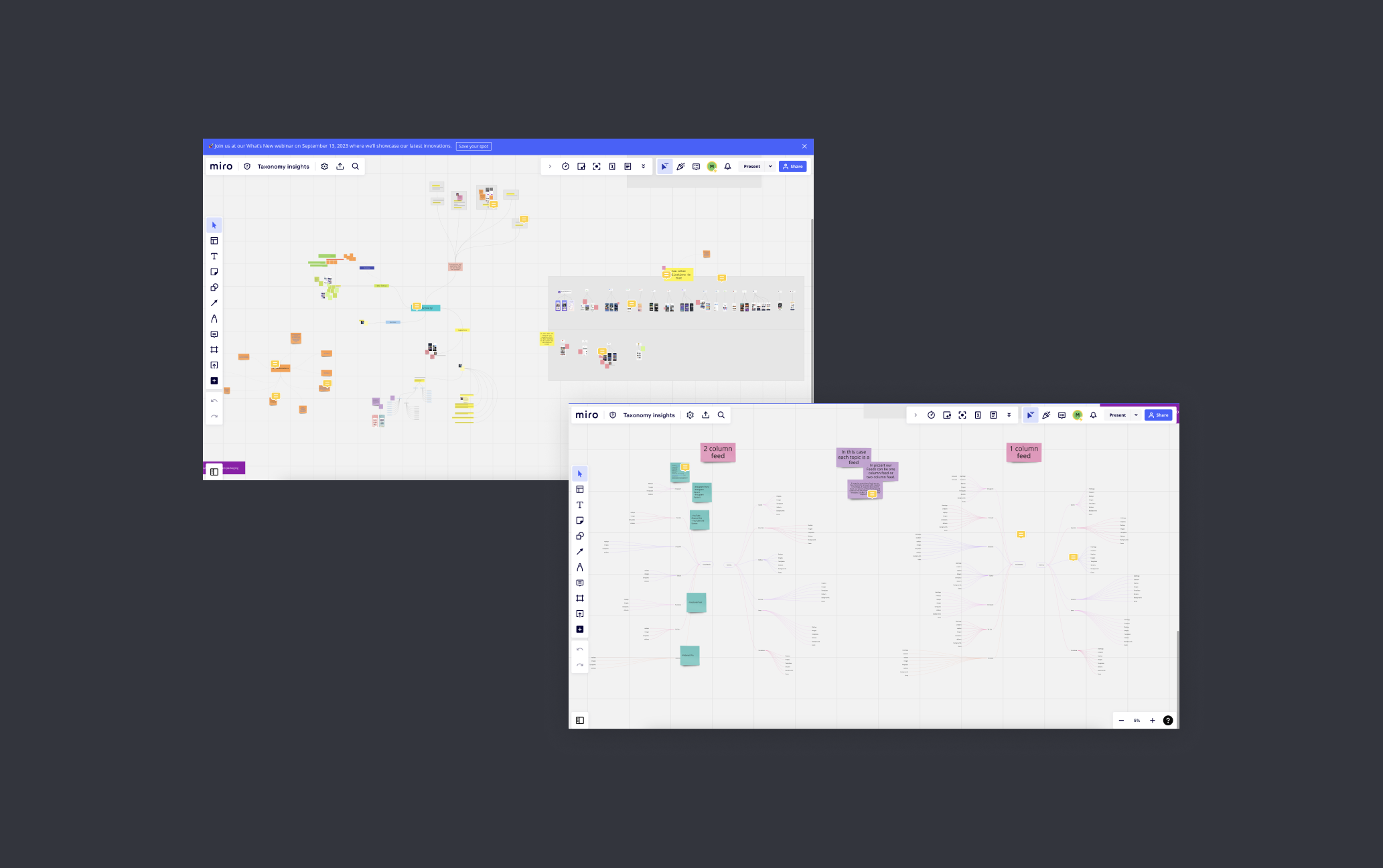
.webp)
| Company | Picsart |
| Product | Content Discovery: Taxonomy & Categorisation |
| My Role | Senior Product Designer · Research · IA · Interaction design · Validation |
| Platform | iOS · Android · Web |
| Users | Consumers and prosumers: creators, solopreneurs, small businesses, marketers |
| Key Decision | Build a browsable taxonomy tree rather than improving the hashtag system. Users needed structured pathways, not more tags. |
| Outcome | 2.5×+ editing engagement target exceeded · Shipped across iOS, Android, and web · Consumers and prosumers served in one unified taxonomy |
Users couldn't distinguish templates, effects, and community content. Consumers left without editing. Prosumers couldn't find relevant content. The Discover screen had been built for people publishing, not people trying to find.
I led the project end to end: research, taxonomy architecture, discovery experience design, and validation across iOS, Android, and Web. I made the core structural call that set the direction: taxonomy over improved hashtags.
A browsable taxonomy that organized Picsart's content library by type, use case, and intent. Editing engagement exceeded the 2.5× target set at project kickoff. Both user segments are served within one unified experience.
The project had four KPIs set at kickoff: editing engagement, discovery rate, subscription growth, and prosumer engagement. The redesigned taxonomy shipped across iOS, Android, and web.

You can't personalize your way out of a structural problem. Before the recommendation engine could help, the content needed to be organized in a way that made intent-based navigation possible. Structure first, then the algorithm has something to work with.
Splitting the product by user type (prosumer vs. consumer) would have imposed a false structure. Users shift between casual browsing and professional intent within the same session. The taxonomy had to serve what someone was trying to do, not who the system had classified them as.
Picsart's differentiator isn't the content library. It's what users can do with it. Remix, Replay, and Regenerate needed to appear during discovery, not after someone had navigated two levels into the editor. Surfacing them while browsing was the call.
A taxonomy built around today's content library would be outdated the moment Picsart shipped something new. The architecture had to accommodate new content types and use cases without needing a structural redesign every product cycle.
Picsart's content library is broad: templates, assets, effects, and community content across every creative use case. But the Discover screen had been designed around the people who contributed that content, not the people trying to find it.
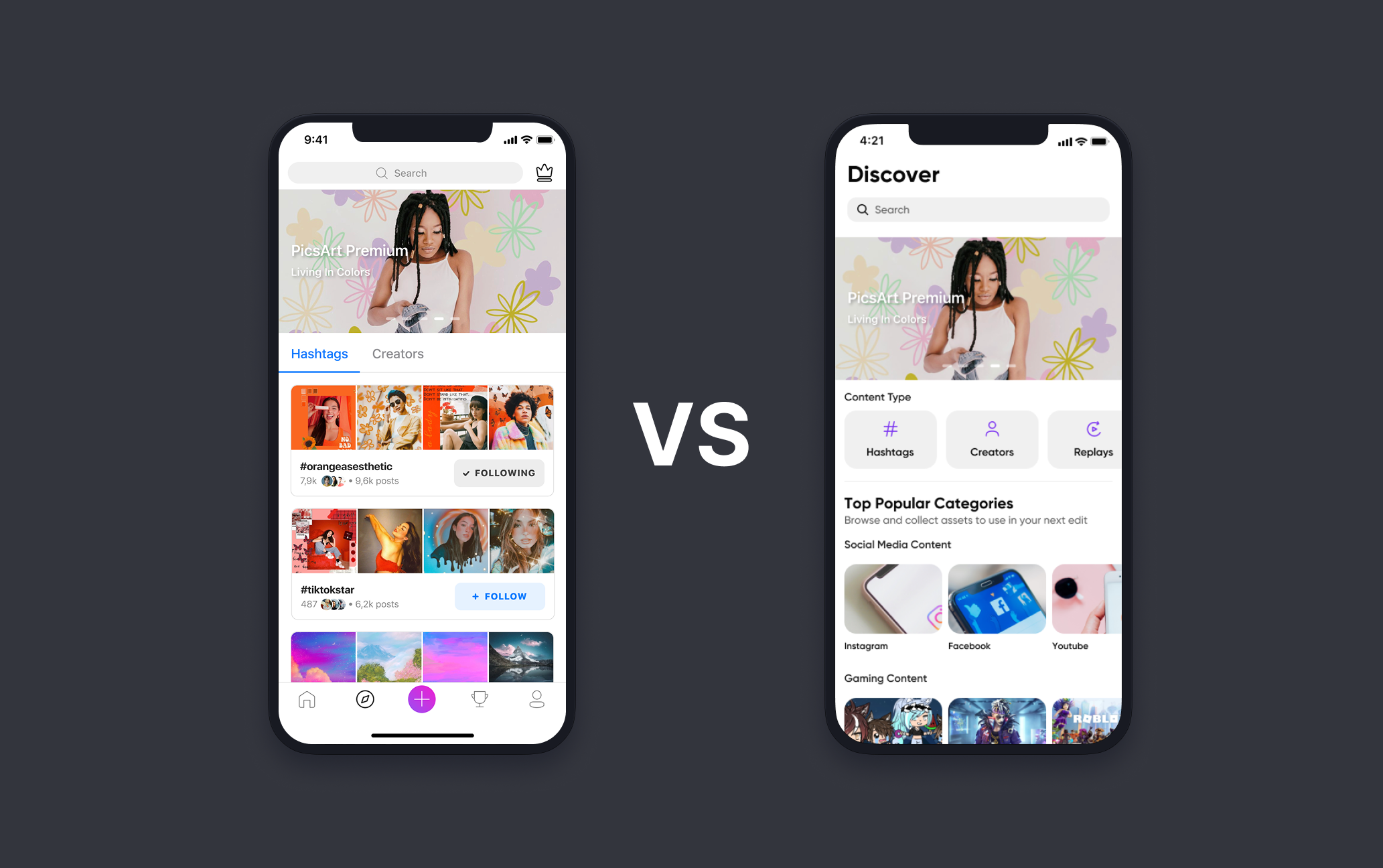
Consumers browsed through hashtag feeds and followed individual creators. That worked if you knew what you were looking for and who made it. For everyone else, the experience stalled. Templates, community posts, effects, and backgrounds were visually indistinguishable. Users scrolled, found nothing that clicked, and left without touching any editing feature.
Prosumers had a different problem. They came with professional intent: marketing materials, social assets, business templates. The existing system had no concept of use case or intent. It surfaced everything to everyone and relied on relevance to emerge on its own.
The research suggested the issue was content organization rather than content quality.
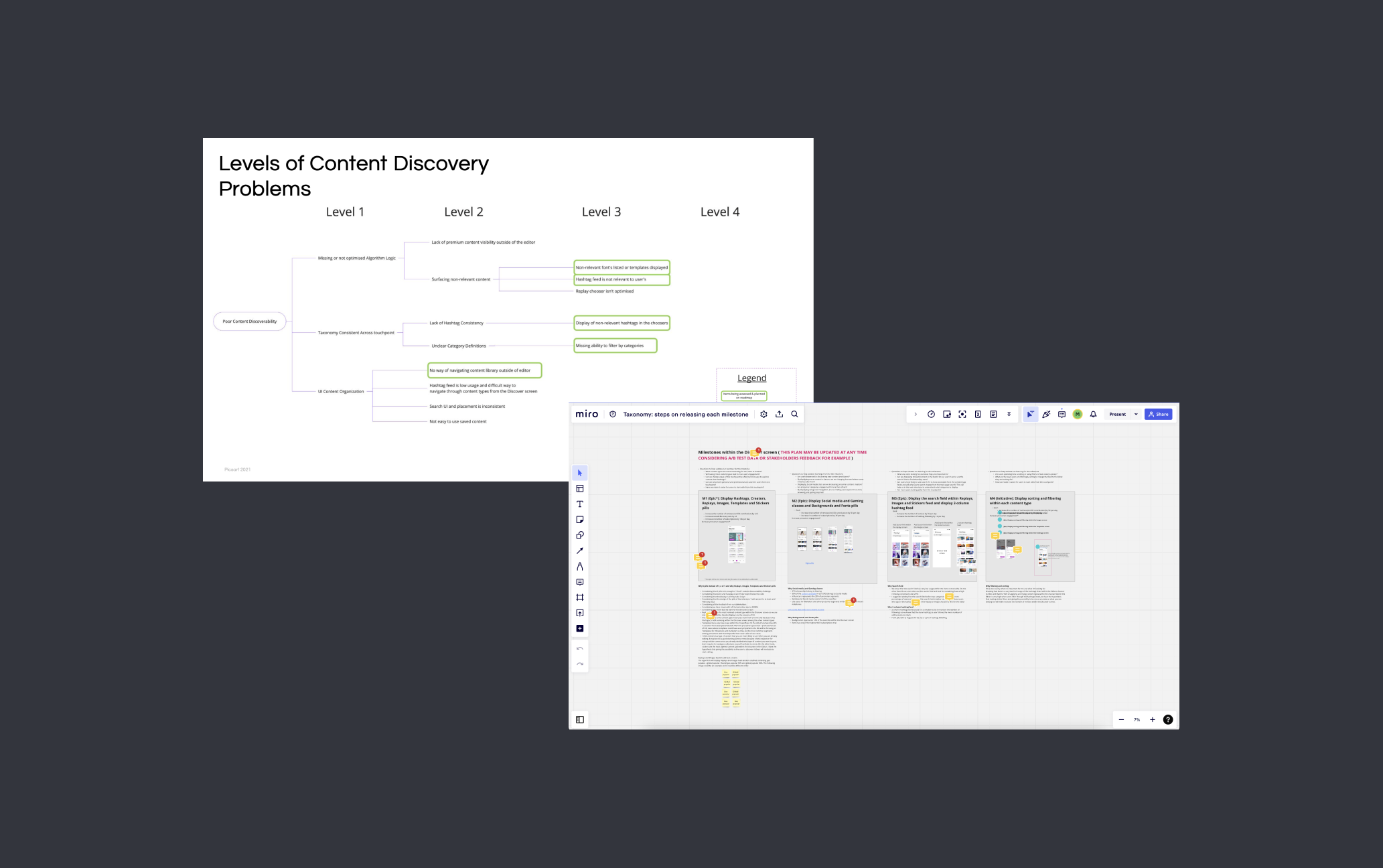
I ran four research methods across the project. They produced different kinds of signal, but they converged on the same diagnosis: Picsart had a content organization problem, not a content quality problem.
Templates, community posts, effects, and backgrounds looked identical in the feed. Users described the experience as "disorganized," not because the content was bad, but because there was no way to navigate toward what they actually wanted.
The existing system was optimized for people publishing content. Users trying to find content for a specific project had no structured path. They either followed individual creators or gave up. Neither behavior drove editing engagement, which was the product's core metric.
Advanced users came to Picsart for professional creative work: marketing assets, social campaigns, business materials. The feed had no concept of creative context or intent. Remix, Replay, and Regenerate (the features that made Picsart useful for this kind of work) were undiscoverable inside the editor, let alone from Discover.
Users wanted content matched to their interests. But a better recommendation engine on top of an unstructured system would just surface the wrong content more efficiently. The taxonomy had to come first. Without it, personalization had nothing to work with.
Each method was designed to answer a specific question. Together, they built the evidence base for the core architectural decision.
The research pointed to a structural problem. Structural problems have competing solutions. These were the two calls I had to make and defend with evidence.
Should we redesign content discovery from the architecture up, or invest in improving the existing hashtag and creator-based system?
The usability test results were the deciding input. Users consistently tried to filter content by type and failed, not because the filter was broken, but because the organizational model didn't support type-based navigation at all. Improving hashtags wouldn't create that concept. A taxonomy would. I built the case with the testing data and got alignment to pursue the taxonomy before moving into design.
Should prosumers and consumers get separate Discover screens tailored to each segment, or share one taxonomy with personalization handling relevance?
The research made it clear that the prosumer/consumer split was messier than it looked. Consumers occasionally wanted professional templates. Prosumers browsed casually before switching into project mode. A hard segmentation would have imposed a structure users don't actually operate within. The unified taxonomy with personalization was the more honest model of how people actually use the product.
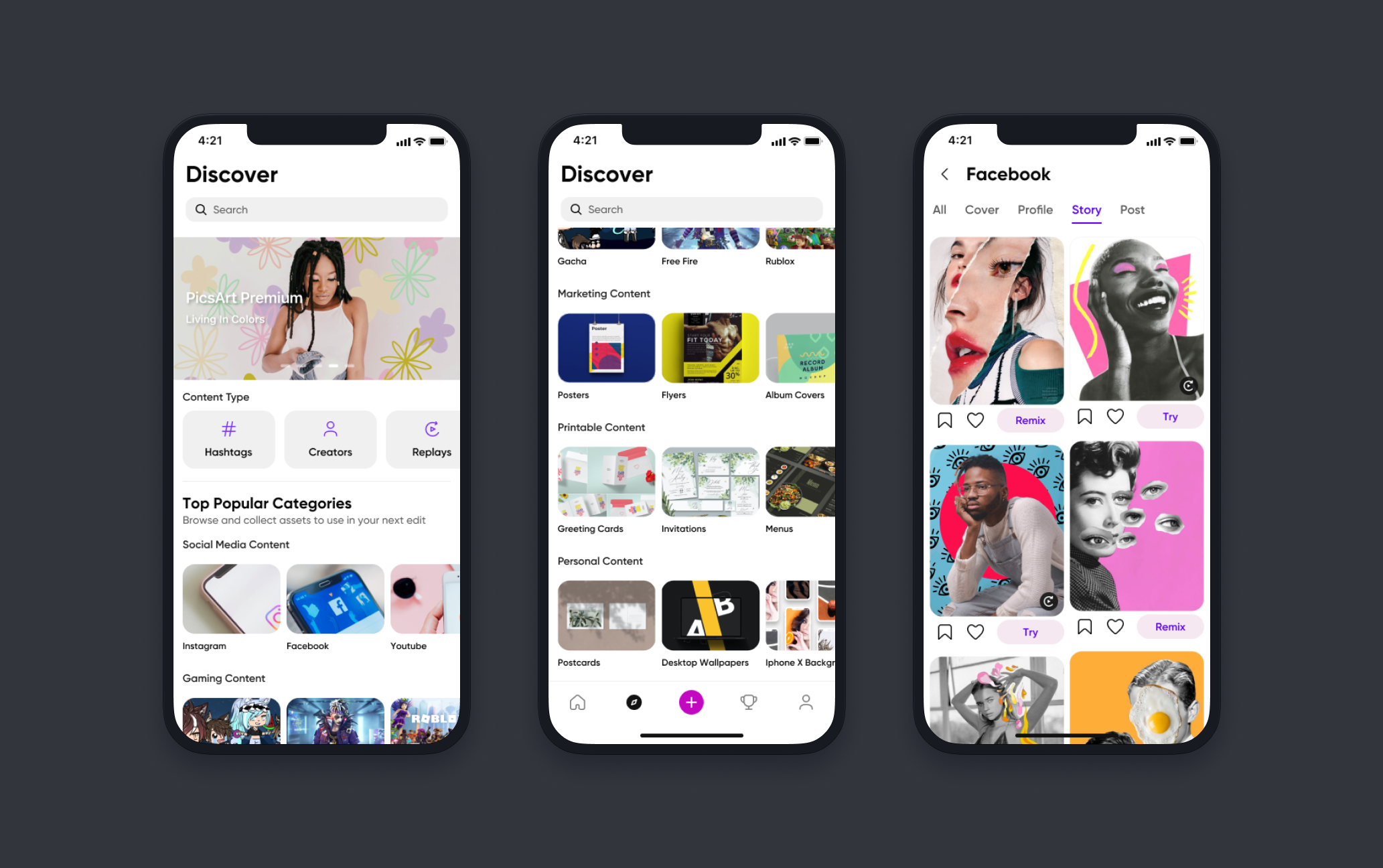
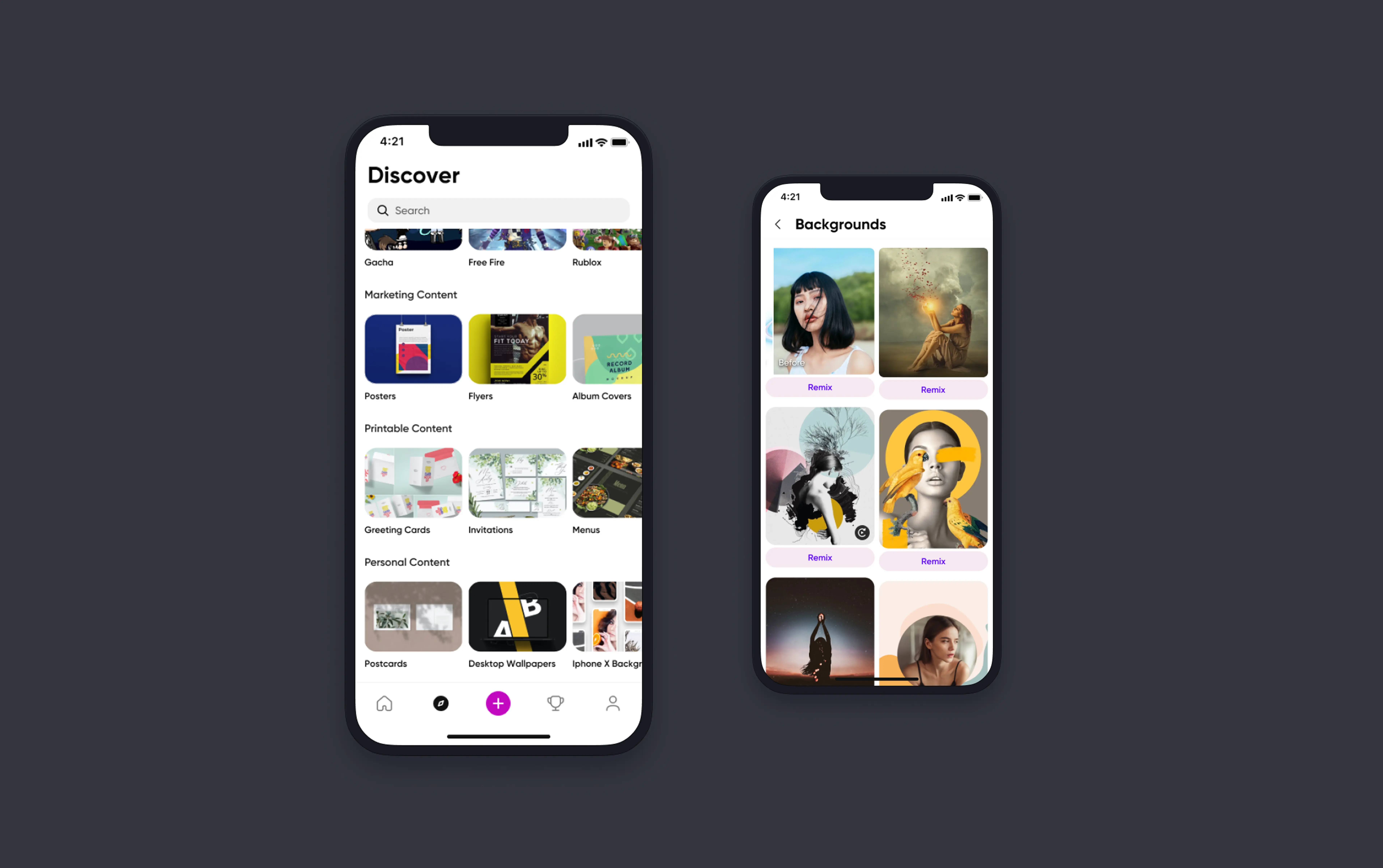
Each element of the redesigned Discover experience connects directly to a documented user problem from the research.
Users had no structured path to find content by type or use case: discovery depended on knowing a hashtag or following the right creator
Clear navigation by content category, use case, and creative context, findable without requiring search terms or creator knowledge
Templates, community posts, effects, and backgrounds were visually indistinguishable in the existing feed
Clear labeling and visual distinction between content types: users know what they're looking at before they tap
Professional-grade content and tools (Remix, Replay, Regenerate) were buried and undiscoverable for advanced users
Dedicated taxonomy categories for professional use cases: marketing materials, social assets, business templates, and the tools to remix them
Content recommendations were generic, unconnected to individual user preferences or past behavior
Taxonomy-anchored personalization that matches content to user interests within the structured navigation, without collapsing the architecture
Save was the only prominent CTA; editing capabilities that differentiate Picsart were invisible from the Discover screen
Inline creative actions surfaced within the taxonomy experience, turning discovery into a direct entry point for editing
Business users needed content mapped to professional contexts (marketing materials, social assets, printables) and couldn't find them
Use-case categories in the taxonomy covering social media assets, marketing materials, and business content, alongside inspiration for influencer creative work
I didn't present a single recommendation and ask for sign-off. Every major decision was validated before it advanced: research, testing, and iteration at each stage.
The combination of qualitative interviews and quantitative surveys gave me clear evidence for every structural call. No decision in this redesign came from a preference or an assumption.

The taxonomy didn't just organize content. It changed how users engaged with it. A 2.5× increase in editing actions was evidence that structure unlocks behavior: when people can find what they're looking for, they do something with it.
The taxonomy solved the right problem. What I underestimated was how much content classification work would emerge after the architecture was approved: edge cases that only surface when real content is being placed into real categories at scale.
The research was solid. Four methods gave me clear signal, and I had alignment on the core decision (taxonomy over improved hashtags) before design began. That alignment held throughout the project, which is the thing I'd work hardest to replicate.
What I'd change is how early I brought content operations into the process. A taxonomy tree is a design deliverable. Making it work as the library grows requires a classification model and an operational process for new assets. I got there, but later than I should have. On a project like this, information architecture and content strategy need to start at the same time, not one after the other.